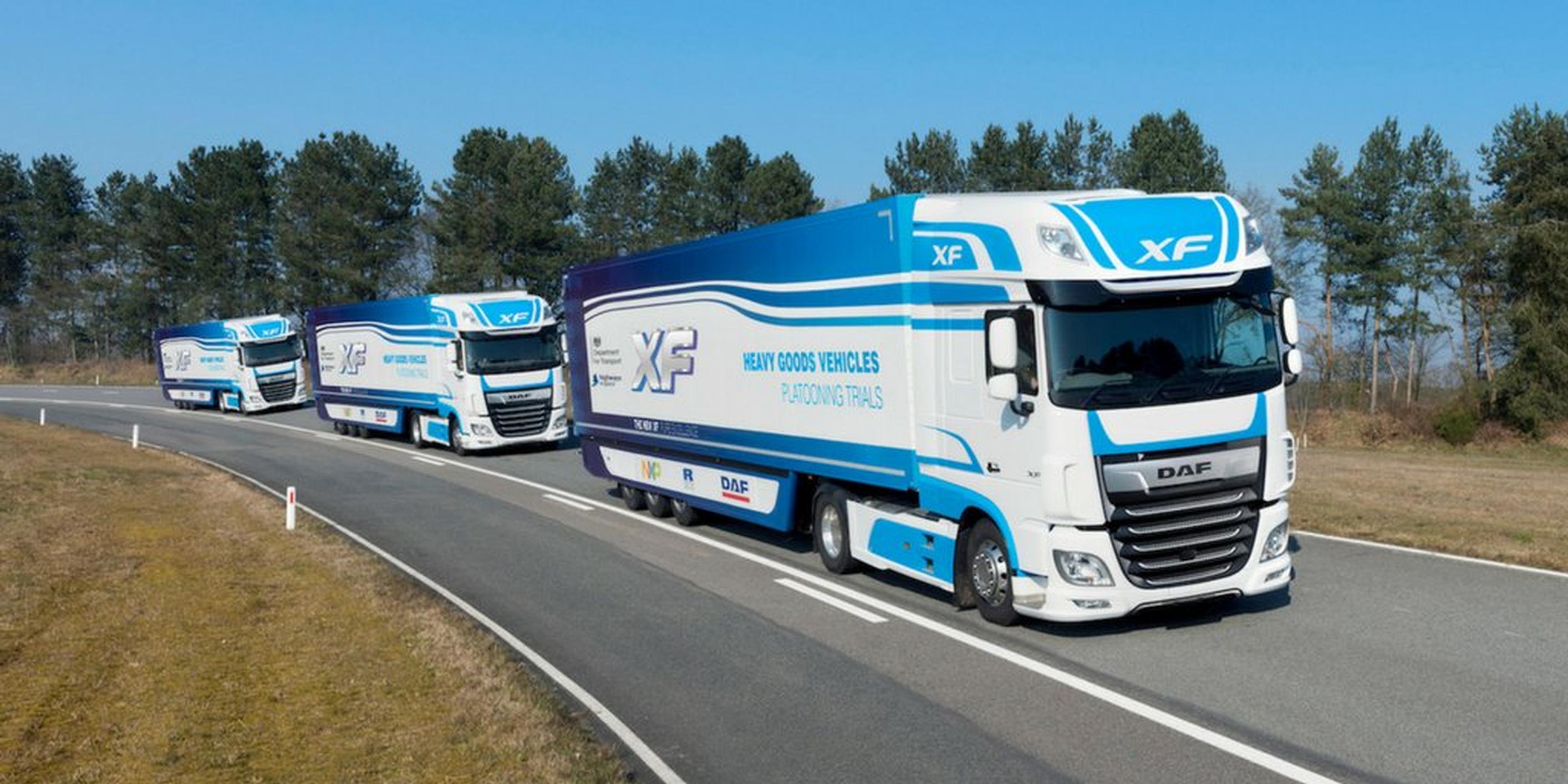
HGV Platooning .. .. what's it all about? .....
Driverless trucks - really?
So it seems the Department for Transport has finally confirmed they will start trials of so called 'Driverless Platoons of HGVs' here in the UK. Off road based trials are due to begin soo and will hopefully lead to on-road trials sometime in 2018. However, is it correct to use the word Driverless? In my opinion, no it isn't. These vehicles will all have a driver in the cab, sitting at the controls and monitoring everything as a driver should do. Checking mirrors, dash warning lights, traffic around them and even a monitor showing the view from a camera mounted on the front truck. What the driver won't be doing is steering, accelerating or braking ...... that is all left to the trucks autonomous systems.
You may already know that as from 1st November 2015 all newly made HGVs over 8000kg have to be fitted with AUtomatic Stability Control (ASC), Lane Departure Warning System (LDWS) and of course Autonomous Emergency Braking System (AEBS). These are all legal requirements. Some of you may have experienced them already, and from drivers that I meet it seems some may have had good and some may have had bad experiences.
So what do ASC, LDWS and AEBS do? And what have they got to do with these 'driverless' trucks?
ASC is fairly simple, its an advance traction control. Using various sensors it can detect and control wheelspin or a vehicle about to slide. By reducing engine torque or even applkying individual brakes on individual wheels the vehicle can help maintain stability. In a lot of cases the driver may not even notice the little flickering light on the dash and have no idea the truck interveined in his driving.
LDWS uses camera technology often referred to as 'paint recognition'. A camera that can 'see' the painted lane markings. If the vehicle starts to drift over a line the driver will be warend with a fairly loud and startling buzz, usually coming from the side of the vehicle that is crossing the line. If the driver indicates correctly, the system remains calm, so it's all down to good driving. Of course this means the truck can actually see the lane markings and so - in theory would be able to follow the lane and remain between the lines.
AEBS is a little more complicated. A small radar unit on the front of the vehicle detects obstructions ahead, perhaps as far as 200+ metres. This radar can check the distance many times a second and report back to the truck how far it is from the object in front and also how fast that object is (or isn't) travelling. The more sophisticated systems such as Volvo (and I am sure some others) also combine this wih '3D Camera' technology meaning the truck can also identify the size, shape and depth of the object. Put these two sets of information together and you have a truck that can see ahead. Link this to the vehicles brakes, give it some simple programming and the truck can now react to an emergency situation.
Don't confuse this with 'Predictive' or 'Adaptive' Cruise control that maintains a sensible distance from the vehicle in front. Those systems may well use the same technology and sensors but the AEBS is there for one reason only - to brake in an emergency situation where the Driver has already failed to react.
So what happens? Different models of truck will have slightly different operating parameters but all work on a very similar way. I'm going to use the Mercedes system combined with their 'Predictive Powertrain Control' system as my example. The radar and cameras monitor the road ahead. If the truck starts to get too close to the vehicle in front a display alerts the driver to the remaining distance to the vehicle ahead and the speed of that vehicle. If the distance continues to reduce and the truck calculates that a collision is imminent, the driver will be warned by a warning light and audible alarm. If the driver still takes no action (which can include braking, accelerating, indicating or steering) the truck will brake itself. Depending on the circumstances it may brake only enough to avoid a collision (the vehicle in front is moving) or as with a stationary object an emergency stop will be performed. During the deceleration and braking phases the hazard lights will flash rapidly, brake lights will be on. Once the vehicle has stopped the hazard lights will be on as normal, handbrake applied and neutral selected In theory, a rear end smash was just avoided.
Here's an example with stationary traffic :
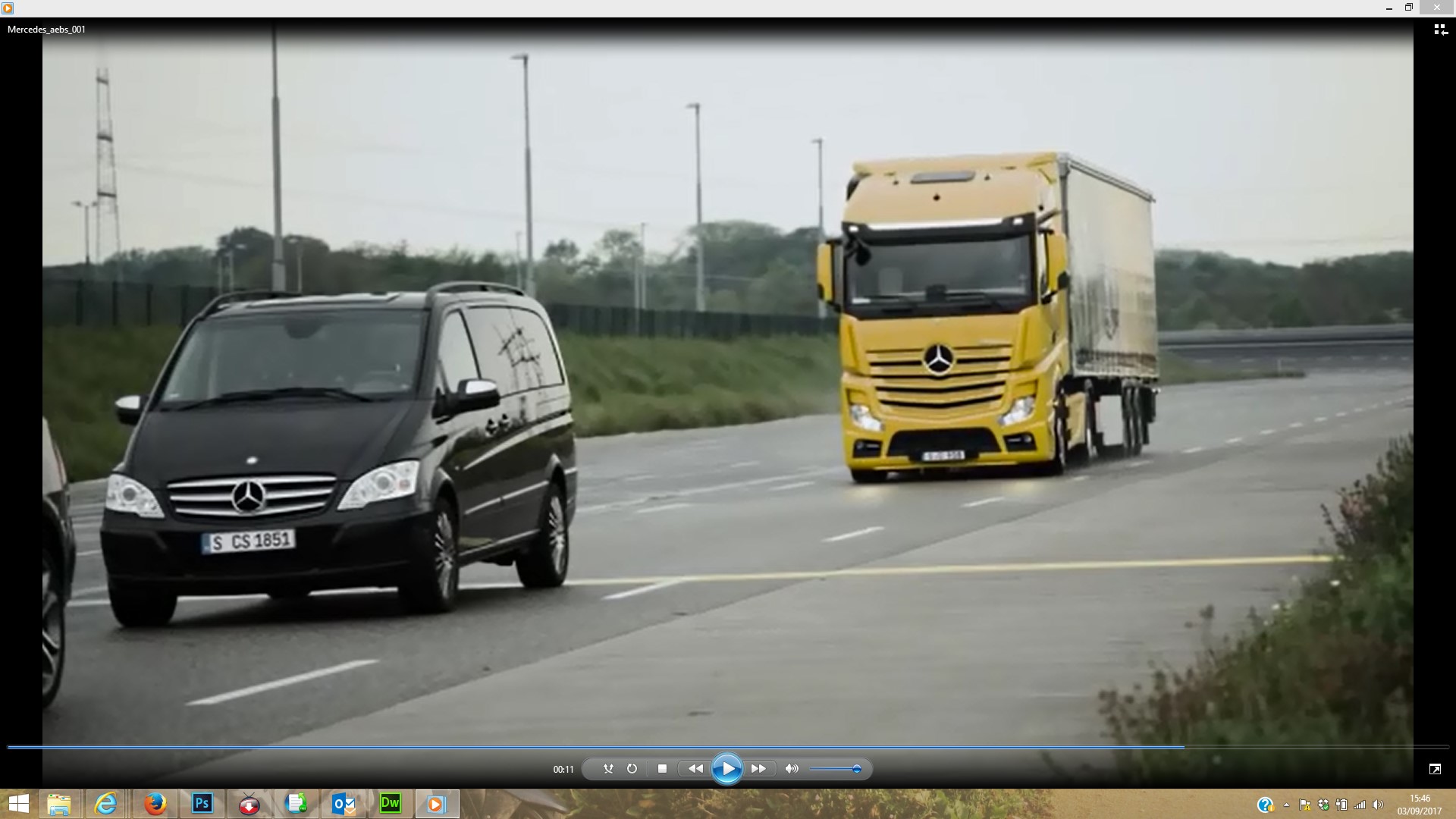
https://www.thetrainingservice.co.uk/images/Mercedes_aebs_001.mp4
Heres an example with slow moving traffic:
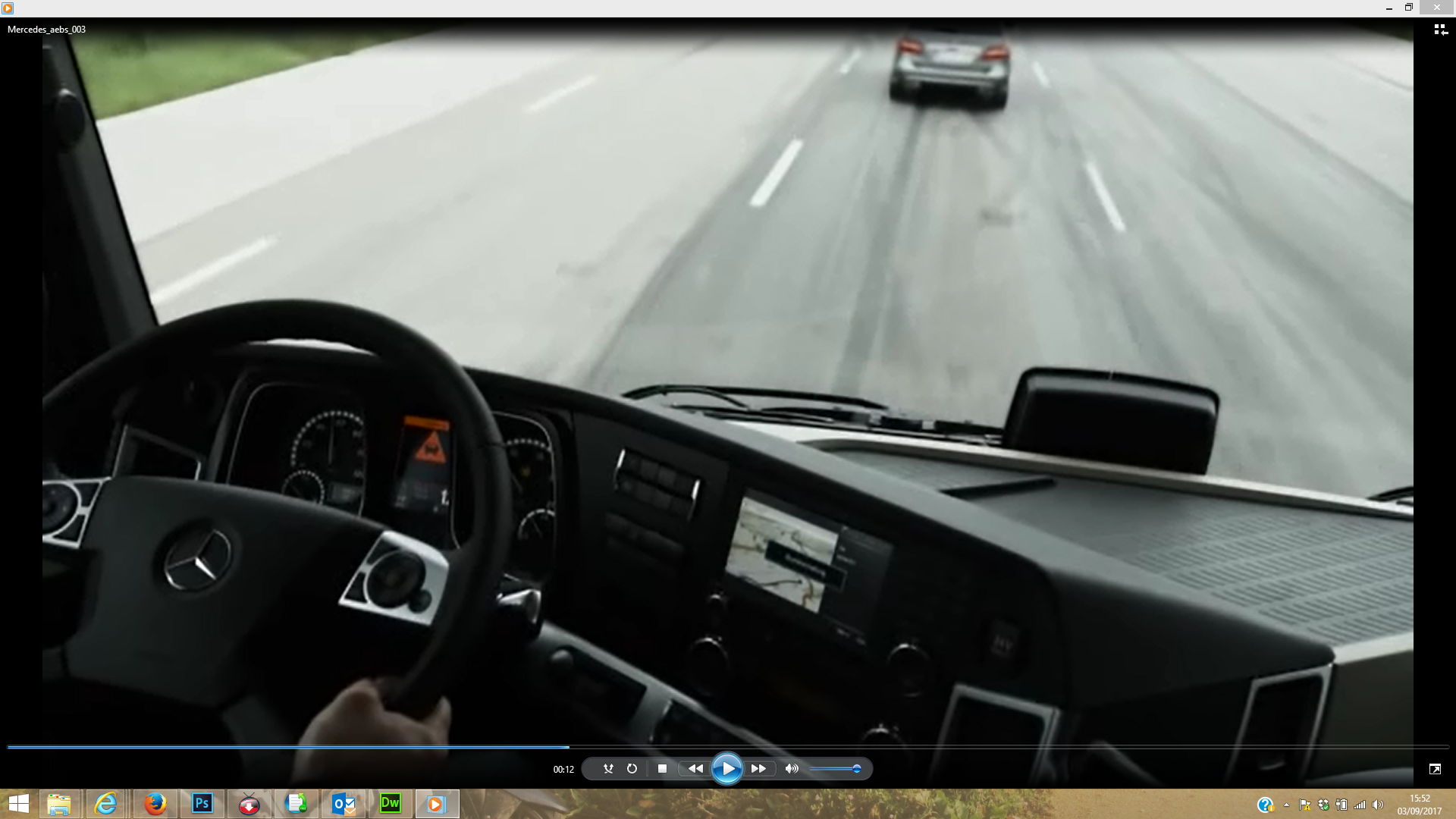
https://www.thetrainingservice.co.uk/images/Mercedes_aebs_003.mp4 Watch the display on the dash carefully and you'll see the distance to vehicle come on giving the driver ample warning.
So what has this got to do with Platooning? Easy, it uses the same systems and principals but adds a few extras such as control of the steering to keep the vehicle in it's lane and a wireless connection between the vehicles to transmit certain data such as speed, proximity and braking. This allows the vehicles to drive much closer together and so gain aerodynamic efficiencies and save fuel and reduce emmissions. Fuel savings of up to 12% are predicted.
The problem we have is human reaction times. An average driver takes around 1.3 - 1.5 seconds to react to the situation in front and get the brakes on. Some are quicker, unfortunately some are slower. Autonomous vehicles in a platoon can react in as little as 0.03 of a second. The front vehicle brakes, the vehicles behind brake within 0.03 of a second. The gap between platooning vehicles will be between 10 to 15 metres, not enough time for a human to react but more than enough for the autonomous truck. We also have to consider that all the time the platoon travels the lead vehicle is scanning the road ahead and transmitting data to the trucks behind, this means they have advance warning of whats going on and can be backing off the throttle in response to this even before any braking is needed. In a way we could describe it as 'safe tailgating' because the electronic systems can react so quickly.
Here's an example of how quickly the vehicles react when the front vehicle has to brake. As you will see the two platooned vehicles brake simultaneously.
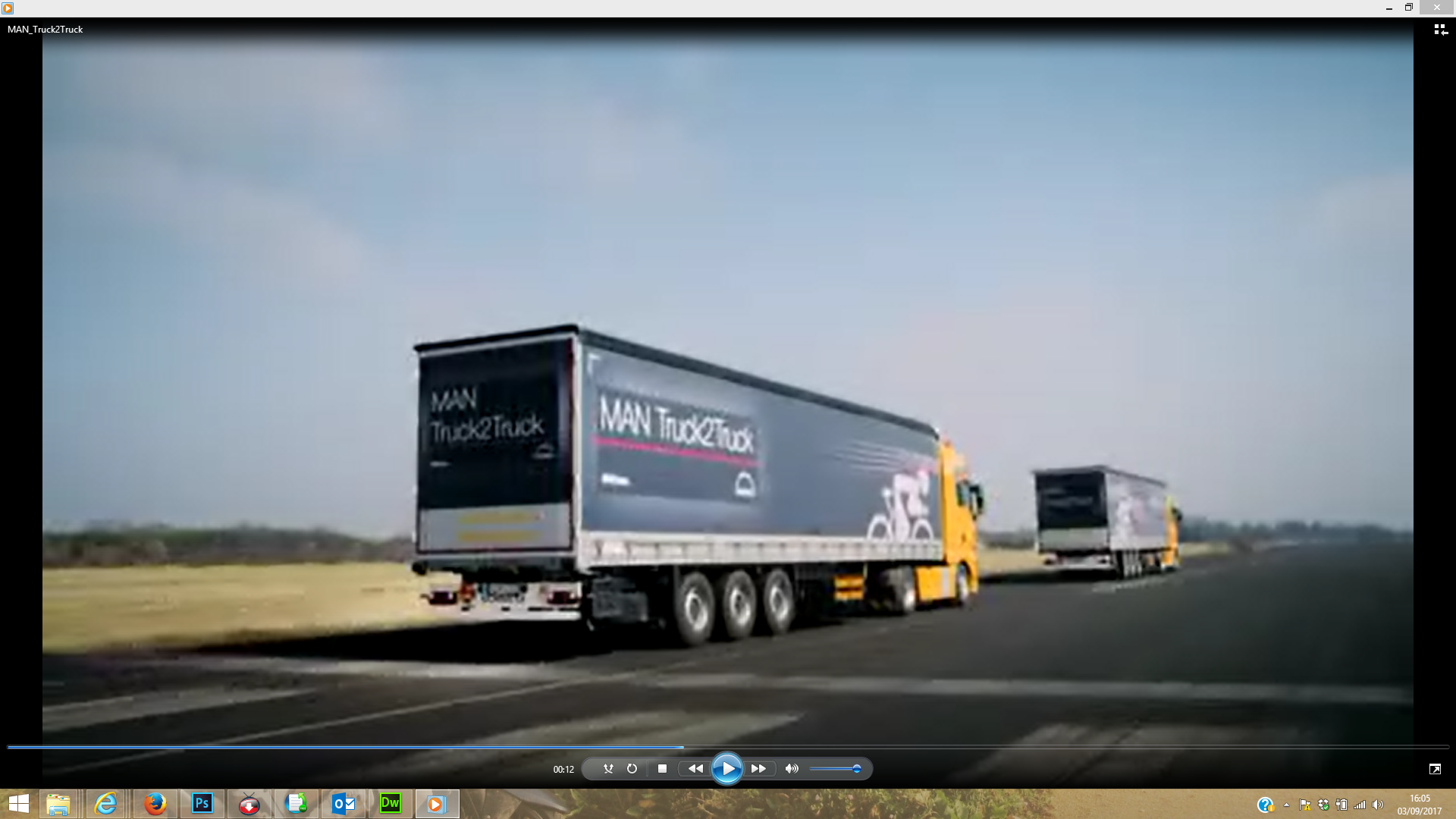
Here we have a video from Mercedes demonstrating their Highway Pilot Connect system being used in live traffic on a live road. You will hear the passenger state that Mercedes have had this system in their trucks for 2 years now, which would suggest it is well on its way to being sorted and safe. As far as I can see it is all about the ability of the onboard systems to react quickly.

http://www.thetrainingservice.co.uk/images/Mercedes_platooning.mp4
Will this be the end of drivers and the start of trucks driving themselves completely? I think it is definitly the start of a journey towards driverless vehicles, but for the foreseeble future a driver is going to be needed for the tricky bits and to monitor and oversee the vehicle at all times. We still have train drivers and we still have aircraft pilots .. .. .. .. For now !
Pete Shepherd
Managing Director
The Training Service Ltd